Anterior Implants with Skeletal Facial Growth
DOT Study Club Recap- Check out a clip from our latest discussion!
The group discussed how unpredictable skeletal growth can be, why implants behave differently than natural teeth, and how this uncertainty can influence treatment planning—especially in young adults. The conversation also explored alternative approaches, like single-wing bonded bridges, and why they can sometimes be a safer, more flexible option.
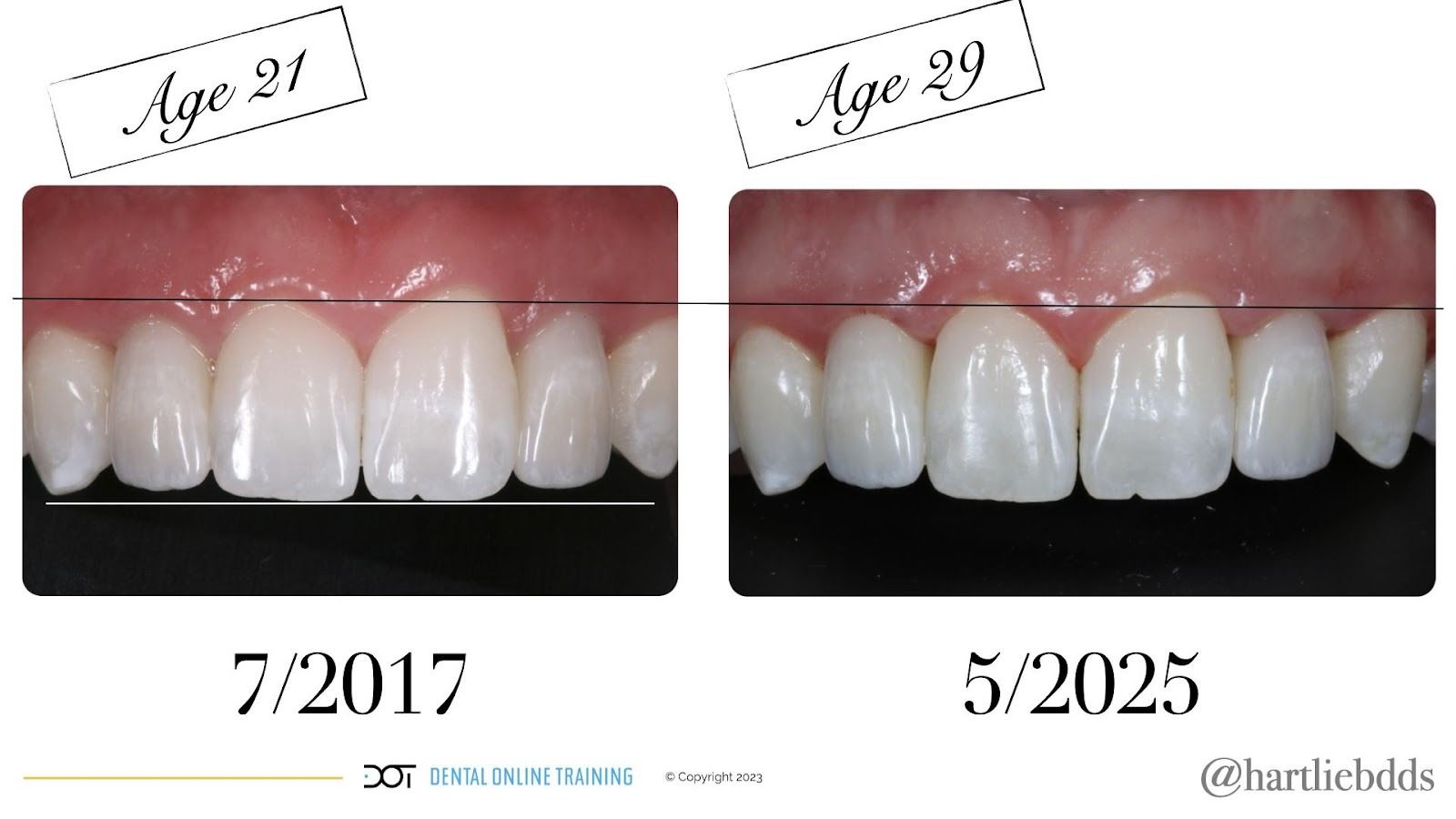
Patient A- Gum levels remain consistent- no skeletal growth
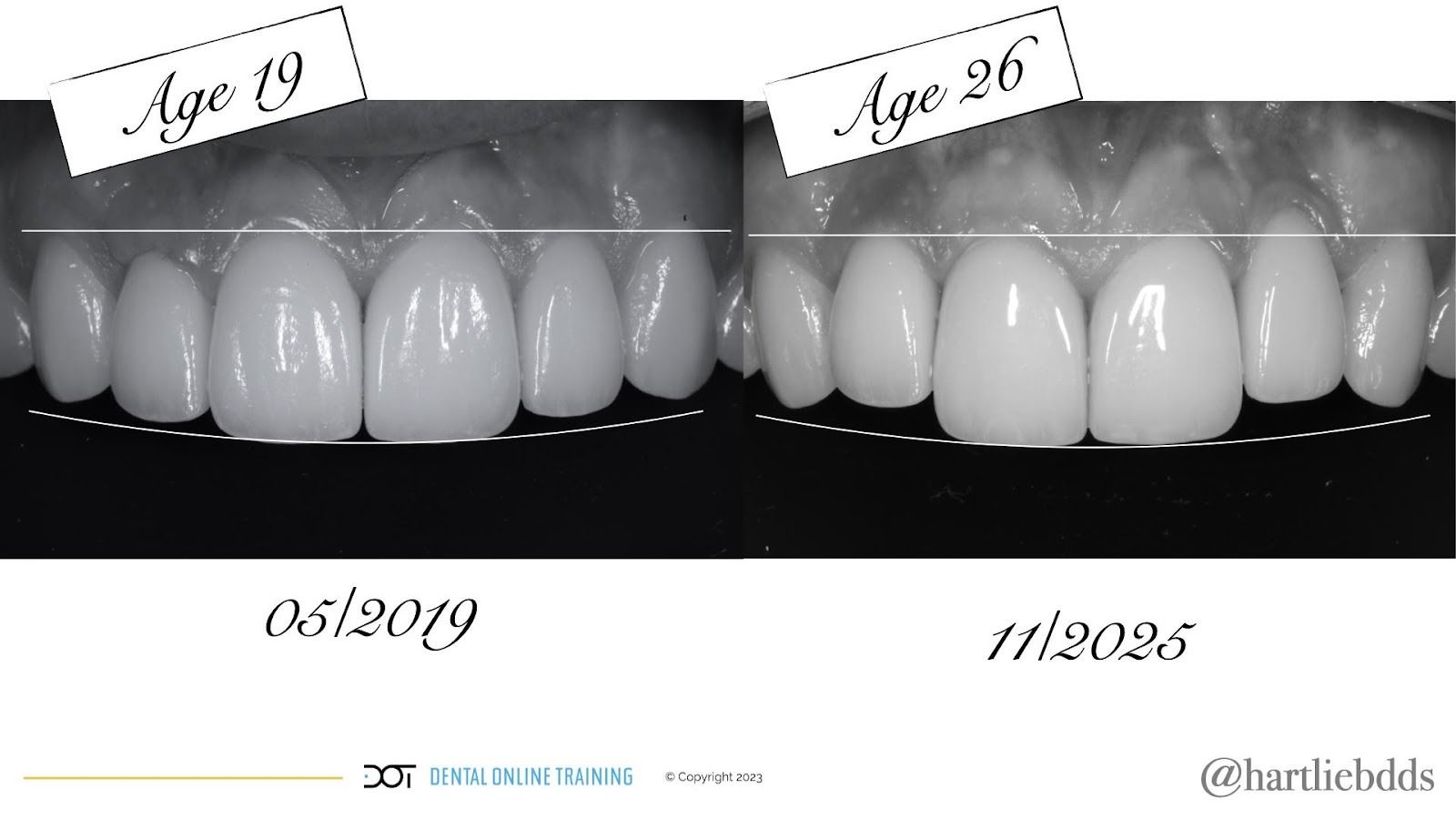
Long-term vertical changes of the anterior maxillary teeth adjacent to single implants in young and mature adults. A retrospective study
J P Bernard 1, J P Schatz, P Christou, U Belser, S Kiliaridis
Abstract

CONNECT
Materials Included
Light Brown tints, Enamelize, Unfilled Resin Flexidiscs, Flexibuffs 1/2", #1 artist’s brush, Silicone Polishing Points, IPC Off Angle Short Titanium Coated Composite Instrument
Materials Needed, not Included
- Loupes
Follow along
You are Registered
-
Erosion and wear – the why and the how
-
Adding length to teeth – when is it safe
-
Opening VDO to compensate for lost tooth structure – where to begin
-
Records visit and key points you need to understand before you start
-
The smile – the 7 strategic points to consider when evaluating the smile
-
Anterior tooth shape, morphology
-
Clinical case review
-
Upper Putty matrix construction
-
Build lingual incisal wall with putty matrix #6 - #11/ Upper anteriors
-
Full contour build-up #6, #7, #8, #9, #10, #11, shape and polish/ Upper anteriors
-
Who – which patients are candidates
-
Why – explaining to patients the value of the prototype
-
How – step-by-step techniques to maximize predictability, efficiency and success
-
Getting to Yes: conversations with patients about esthetic and reconstructive dentistry
-
The ‘Smile Preview’ – techniques to show the possibilities
-
Lower Putty matrix construction
-
Build lingual incisal wall with putty matrix #22 - #27 / lower anteriors
-
Build-up #22 - #27, shape and polish / lower anteriors
-
Build-up lower occlusal posteriors
-
Demonstration of Smile Preview
Upcoming Virtual Workshops
-
01/22/2026
-
04/09/2026
-
06/11/2026
-
10/15/2026
-
12/10/2026
-
01/16/2026
-
02/13/2026
-
03/20/2026
-
04/10/2026
-
05/08/2026
-
06/05/2026
-
08/21/2026
-
10/09/2026
-
11/20/2026
-
12/10/2026
Popular On-Demand Courses
You are Registered
Injection Moulding Workshop
Learn a simple, predictable approach to to start your journey with injection moulding.
Write your awesome label here.
Dr. Ryan Springer
-
December 11, 2026, 9am to 4pm CST
-
6 CE Credits (AGD CODE: 250 )
-
Join virtually via Zoom
Lecture
Review basic material selection and the basic step-by-step procedural technique.
Hands-on Practice
Follow along with Dr. Springer and learn a systematic foundation for predictable injection moulding.
CPR for the Worn Dentition Workshop
Learn how to treat dental erosion and wear, protect the teeth, and open vertical dimension.
Write your awesome label here.
Dr. Dennis Hartlieb
-
March 18 & 19, 2027 9am to 4pm CST
-
14 CE Credits (AGD CODES: 180, 250, 610, 780)
-
Join virtually via Zoom
Lecture
Learn everything you need to know to treat severe wear cases.
Hands-on Practice
Follow along with Dr. Hartlieb and learn the step by step techniques.
Ortho and Restorative Dentistry through Digital Dentofacial Planning Workshop
Discover how digital analytics and workflows connect tooth movement restorative design.
Write your awesome label here.
Dr. Jennifer Bell
-
January 15, 2027 9am to 4pm CST
-
6 CE Credits (AGD CODES: 250, 370, 610, 780)
-
Join virtually via Zoom
Lecture
Integrate orthodontic treatment planning software into restorative workflows.
Hands-on Practice
Participants will digitally plan a case, experience a “smile try-in,” and use a digital wax-up guide.
Ceramic Onlay Prep and Cementation Workshop
Write your awesome label here.
Dr. Dennis Hartlieb
-
May 21, 2027 9am to 4pm CST
-
7 CE Credits (AGD CODES: 180, 250, 610, 780 )
-
Join virtually via Zoom
Lecture
Learn everything you need to know to testtest
test
Hands-on Practice
Follow along with Dr. Hartlieb and learn the step by step techniques.
Diagnosis–Driven Splint Therapy Workshop
Learn everything you need to know about splint selection & design.
Write your awesome label here.
Dr. Curt Ringhofer
-
June 18, 2027 9am to 4pm CST
-
4 CE Credits (AGD CODE: 180)
-
Join virtually via Zoom
Lecture
Learn steps involved in delivering a splint and how diagnosis influences splint design.
Hands-on Practice
Follow along with Dr. Ringhofer and learn the step by step techniques.
Porcelain Veneer Preparation Workshop
Learn a systematic, predictable approach to porcelain veneer preparation.
Write your awesome label here.
Dr. Zach Sisler
-
October 29, 2027 9am to 4pm CST
-
7 CE Credits (AGD CODES: 180, 250, 780 )
-
Join virtually via Zoom
Lecture
Learn key prep design principles, including margin design and seamless margin transitions.
Hands-on Practice
Follow along with Dr. Sisler and learn the step by step techniques.
3D Printing for the Restorative Dentist: Digital Design and Planning Workshop
This exocad-based workshop is focused on digitizing your patient to aid in treatment planning.
Write your awesome label here.
Dr. Seth Atkins
-
September 17, 2027 9am to 4pm CST
-
7 CE Credits (AGD CODES: 250, 780, 610)
-
Join virtually via Zoom
Lecture
Learn how to design splints, inlays, onlays, crowns, and digital waxups/mockups with digital design
Hands-on Practice
Work through design workflows and learn how to shape each design to support predictable use.